The Science of Suffering (Less)

Picture this: you're sitting there, book open, staring at Korean words that looked familiar yesterday but now might as well be hieroglyphics from another galaxy. Your brain feels like it's simultaneously overheating and shutting down. The voice in your head is getting louder: "I'm just not good at languages. Korean is too hard. Maybe I should've stuck with Spanish."
Sound familiar? Just like me, fr
That feeling - that special blend of frustration, shame, and near-existential dread that comes with language learning plateaus - nearly broke me when I was learning Korean. It wasn't until I was introduced to some ancient wisdom that I finally understood what was happening in my brain - and how to fix it.
Here's the wild part: I think part of the solution to our modern language learning struggles was figured out by a guy sitting under a tree 2,500 years ago.
[locked]
Your Brain on Language Anxiety
Like fevers, anxiety is a response your brain has to danger - the problem is, your brain doesn't differentiate well between "I can't understand this much Korean" and "That might be a tiger in the bushes." Both flip the same internal switch that floods your system with stress hormones and initiates a whole smörgåsbord of physiological effects. Sorry, I just wanted to say smörgåsbord.
I think this concept is related to what Dr. Stephen Krashen discusses with his "Affective Filter Hypothesis" - a barrier to language acquisition that isn't intellectual, but emotional. Our brain's response to these negative emotions includes the prevention of language input from reaching the acquisition centers of our brain.
So what do we do? Well, we turn to one of the most powerful techniques of cognitive behavioral therapy (CBT) for anxiety, called "cognitive restructuring." It's the fancy psychology term for "changing how you think to change how you feel." Not quite as cool as smörgåsbord, but still pretty cool.
CBT (no, not that one)
CBT is an evidence-based approach developed by psychiatrist Aaron Beck in the 1960s that's now the gold standard for treating depression and anxiety disorders, with success rates between 60-70% in clinical settings. It's an empirically effective talk therapy treatment.
To explain the concept in my own words: our emotions are responses to our interpretation of external stimuli, and our thoughts, both conscious and unconscious, are those interpretations. Keeping in mind that anxiety can be triggered when no real danger is present, the logic here is that actively interrupting our thoughts and adjusting the pattern is a way to regulate those emotions.
Cognitive restructuring isn't saying "just relax," it's focusing on reprogramming the stress loop by examining the internal scripts you're running - for example:
- "I should already be fluent."
- "I sound stupid when I speak."
- "Everyone else is better at this than me."
Thoughts like these aren't really facts - you don't know you should be fluent, and you're much worse at knowing what other people are thinking than you think you are. These are interpretations of your experience.
The process of cognitive restructuring involves identifying, questioning, and reframing thoughts like those that are "distortions" of reality. This isn't just positive thinking though, this is accurate thinking.
So let's recap - distorted thoughts can create a negative feedback loop with our nervous system that can spiral into real physiological effects, but science shows that we can use this system to our advantage by interrupting and restructuring those thoughts as a form of treatment.
The Four Noble Truths
Here's where things get interesting. While cognitive restructuring feels like a modern development in psychology (and it is), I think the basic framework was outlined roughly 2,500 years ago by a cool guy named Siddhartha Gautama, aka the Buddha.
Like I discussed in my video on this topic, The Four Noble Truths (사성제 in Korean) weren't just philosophical musings - they were the original cognitive restructuring system. While Aaron Beck was developing CBT in the 1960s, he was essentially rediscovering principles that had been field-tested across cultures for over two millennia.
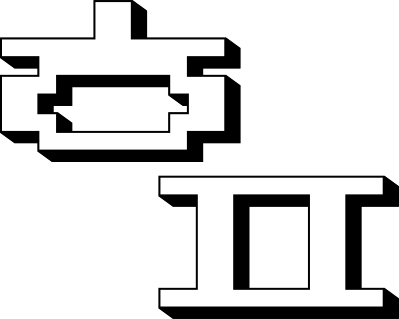
The ancient framework of the Four Noble Truths, or 사성제, starts with acknowledging that 고 (苦), translated as suffering, un-satisfactoriness, stress, or unease, exists.
This character gets used in other words like 고생 (struggling, suffering), 고통 (pain), and 고민 (worrying about something). In English, it's translated as a few different things, because it's all of them: suffering, dissatisfaction, stress, and that general feeling of "unease."
So on our journey, we will experience this 고, this unease, or dissatisfaction.
We experience this in plenty of contexts:
- Feeling disappointed when we make mistakes
- Being treated like an outsider
- Anxiety about whether or not you're using your time effectively
- Comparing yourself to others and feeling discouraged
- Fear about tests, or just using the language in general
Some scholars interpret these truths as also coming with a task, and the task for 고 is to understand it.
We are tasked with learning what it feels like, recognizing when we're feeling it, and by doing so, learning not to be caught off guard when we inevitably experience it.
In other words, when it comes to 고, we need to learn to perceive it.
The second noble truth in Buddhism is that 고 has a cause, called 집 (集). 집 is identified as the origin or cause of our 고. What the Buddha described as 집 can be translated as “craving”, “attachment”, and even “ignorance.” More specifically:
- Craving for things we do not have (고 comes from craving them)
- Attachment to things we do have (고 comes from losing them)
In language learning terms, this can be interpreted as:
- The attachment we have to our own idea of how the process should happen, and what progress looks like.
- It's the craving for certain outcomes, regardless of whether or not they're realistic (or even possible.)
- The ignorance of - or resistance to - the way things truly work.
The task that comes with the second noble truth is to abandon our 집. No, don't abandon your house, you're still gonna have to pay property taxes - who am I kidding, no one owns houses anymore!
If we learn to perceive 고, the next step is learning to intuit the things that are causing it (which this framework diagnoses as 집) and letting them go.
The third truth offers hope: there is an end to 고 - freedom from the mental hamster wheel.
For this one, we use 멸 - a character you'll find in words like 소멸 (disappearance) and 멸종 (extinction). In English, this concept is usually translated as “cessation” or “ending”.
Our task is to “realize” 멸, with “realize” here meaning “make it real”.
The fourth and final noble truth is that there is a way, 도(道) which is a really common character. It represents the path, the way, or method. In Korean, you'll hear it in words like 도로 - it's also the same character that's the one they use for the “Dao” in “Daoism.”
If you've ever heard about Buddhism before, you've probably heard of “the Eightfold Path” - well, this is that path. As I'm sure you can imagine, the task associated with this one is to follow the path.
So to recap: we experience negativity on our journey, its cause can be identified, it can be fixed, and there's a structured way to fix it.
Brain Hacks for Korean Learners: Practical Application
So how do you actually use this ancient-but-scientifically-validated approach? The key is to catch your unhelpful thought patterns and reframe them. When you feel that negativity creeping up, pause and ask: "What am I thinking right now?" Identify the specific negative thought you're having. Ask yourself, then, if that thought is based in reality. If it isn't, let it go.
What I love most about this is its universality. Whether you're learning Korean, starting a business, or trying to get in shape, the principles are identical: honestly acknowledge the inevitability of 고, identify thought patterns creating unnecessary 고, recognize these thoughts are changeable, and practice more helpful ways of thinking in order to create that change.
Conclusion
My journey of learning Korean took me to my breaking point. The frustration, embarrassment, feeling that I had blown my chance at a future by moving to Korea - all of it was amplified by my own thought patterns.
If someone had sat me down and explained this ancient cognitive framework earlier, I would have suffered a lot less. I wouldn't have wasted so much time letting my thoughts interrupt my language acquisition process. That being said, the way I see it now is that the time wasn't wasted if I can share what I learned. Taking this to heart and passing it on to another learner will make it it all worthwhile.
So the next time you feel that Korean-induced brain freeze happening, remember: your thoughts are creating that response, and your thoughts can be changed. You're not bad at languages - your brain is just doing exactly what brains do when certain thought patterns take hold.
The Buddha figured this out 2,500 years ago. CBT therapists rediscovered it in the 1960s. Neuroscientists are confirming it today. Now you know it, too.